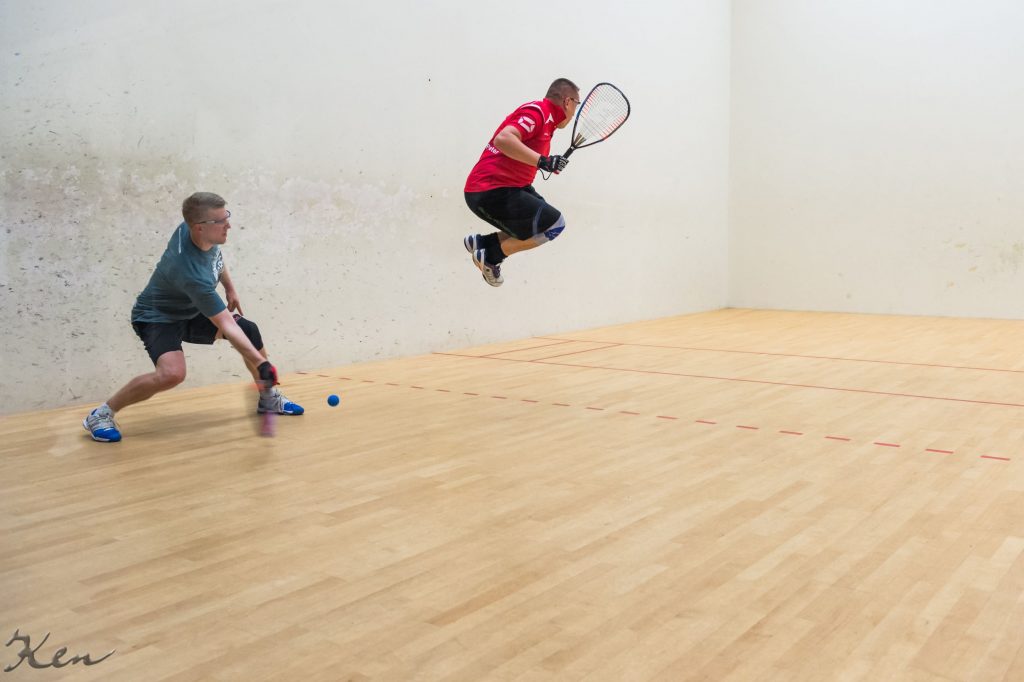
How to play racquetball
Racquetball is a fast-paced racquet sport played with a hollow rubber ball on an enclosed court. The sport was created by Joe Sobek in 1949, combining elements of squash and handball.
Unlike many other racquet sports, the walls and ceiling are part of the playing area, allowing the ball to be played in almost every direction.
Racquetball is most commonly played as singles (two players) or doubles (four players), although a three-player version known as cut-throat is also popular.
TYPES OF GAMES
Racquetball is played by two (singles) or four players (doubles). A variation of the game that is played by three players is called cut-throat. In cut-throat, one player serves and the other two players are his/her opponents. If the server wins the rally, they score a point. If they lose the rally, one of the other players becomes the server. The players take turns being the server as each player serving loses a rally.
OBJECTIVE
The objective is to win each rally by serving or returning the ball so the opponent is unable to keep the ball in play. A rally is over when a hinder is called or when a player (or team in doubles): 1) is unable to hit the ball before it bounces twice, or 2) is unable to return the ball in such a way that it touches the front wall before it touches the floor.
POINTS AND OUTS
Racquetball uses rally scoring. A point is awarded at the end of every rally, regardless of which player or team served. In doubles, when the first server loses the serve, the second server then serves. After the second server loses the serve, it is a side out.
MATCH, GAME, TIEBREAKER
A match is played as the best of five games. The first four games are played to 15 points. If a fifth game is required, it is played to 11 points.
BASIC RULES
The Serve
The server bounces the ball once and strikes it with the racquet. The ball must hit the front wall first and then pass the short line before touching the floor.
The Rally
After a legal serve, the players alternate hitting the ball. Each player must return the ball to the front wall before it touches the floor twice.
One Bounce
The ball may be returned before it bounces or after one bounce. If the ball bounces twice before being returned, the rally is over.
Using the Walls
Players may use the side walls, back wall and ceiling during a rally. The ball must ultimately reach the front wall before touching the floor.
Hinders
Players must give their opponent a fair opportunity to see and play the ball. If interference occurs, play may be stopped. Depending on the situation, the rally may be replayed or a penalty hinder may be called.
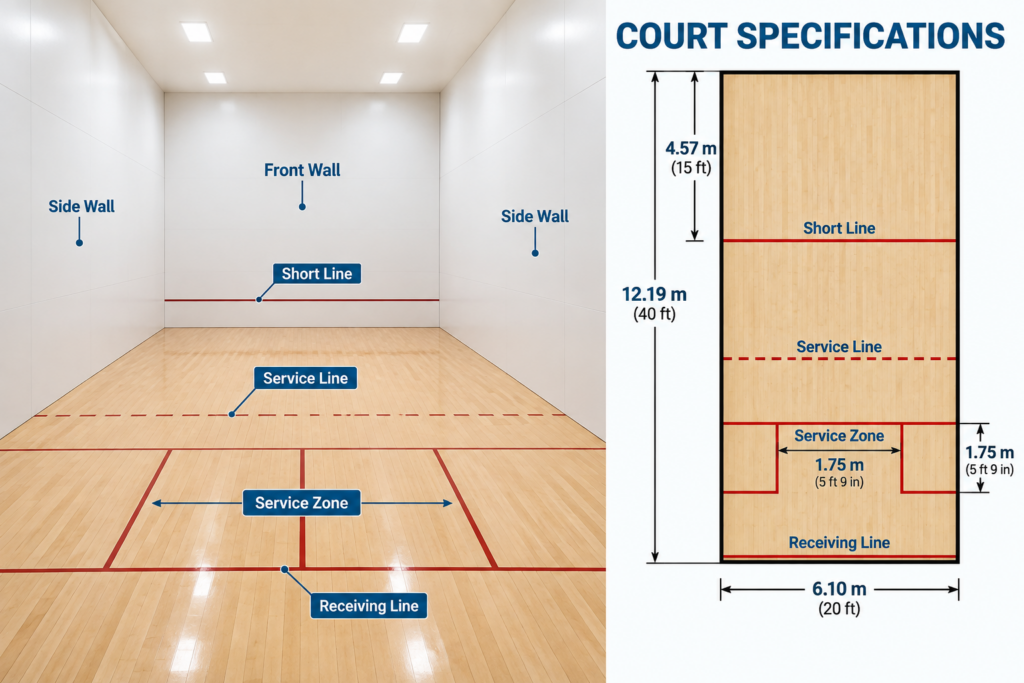
COURT SPECIFICATIONS
The specifications for the standard four-wall racquetball court are: Dimensions. The dimensions of an indoor court are 20 feet wide, 40 feet long, and 20 feet high. Outdoor courts may be shorter and without back walls. All surfaces are in play, with the exception of any gallery opening, and surfaces designated as out-of-play for a valid reason (such as being of very different material or not in alignment with the back wall).
COURT MARKINGS
Short Line. The short line is midway between the front and back walls. The serve must hit the front wall and then not bounce before crossing the short line in the air.
Service Line. The service line is five feet in front of the short line. It is the line closest to the front wall.
Service Zone. The service zone is the 5’ x 20’ area bounded by the short line and a dashed line parallel to the short line (receiving line). The zone is observed only during the serve. Neither the server nor receiver may enter the zone until the ball has either hit the floor or crossed the line.
EQUIPMENT
Racquet
A racquetball racquet with a securely attached wrist cord is required.
Ball
Racquetball is played with a hollow rubber ball specifically designed for the sport.
Protective Eyewear
Protective eyewear designed for racquet sports should always be worn and is mandatory in official competition.
Shoes
Non-marking indoor court shoes provide the grip and stability needed for quick movements and changes of direction.